

Learn to separate money and self-worth. This guide offers a step-by-step plan to build confidence from within, breaking the link between income and personal value.
Table of Contents
Disclaimer: Some links on this site are affiliate links. This means I may earn a small commission if you click or make a purchase, at no additional cost to you. I only share products I have used and trust.
The Shameful Truth About Money & Self-Worth
You check your bank account and feel a familiar pang of inadequacy. That number seems to whisper judgments about your intelligence, your effort, your very value as a person. This quiet shame, where financial status gets tangled with personal worth, is a heavy burden many carry in silence. It’s a painful equation: low income equals low value.
For over a decade, I’ve worked as a reality architect, guiding individuals through the complex relationship between their external circumstances and internal world. I’ve witnessed firsthand how this money-self-worth link creates suffering and limits potential. This guide is built from that experience, offering a path to genuine freedom.
This article will help you untangle net worth from self-worth. We’ll explore what this connection really is, the profound benefits of separating them, and provide a clear framework to build confidence from within. We’ll also identify common traps so you can navigate this journey with clarity. By the end, you’ll have a practical roadmap to valuing yourself independently of your finances.
What Is the Link Between Money and Self-Worth? A Clear Definition
At its core, the money-self-worth link is the internalized belief that your financial metrics—income, savings, possessions—are a direct report card on your character, capability, and value as a human being. Think of it less as a financial issue and more as an identity framework where worth is externally sourced.
It’s often confused with financial ambition or prudent money management, but there’s a key distinction:
- While financial ambition focuses on goals and growth, the money-worth link is concerned with basing identity on outcomes.
- Unlike prudent management, which is a practical skill, this link requires constant emotional validation from bank statements.
Understanding this definition is the initial move toward changing it.
The Proven Benefits of Separating Money from Self-Worth: Why It Matters
Why invest energy in this separation? Based on psychological research and my professional observations, here are the most significant benefits:
Benefit 1: Emotional Stability & Reduced Anxiety
When your sense of security isn’t hitched to market fluctuations or a paycheck, you gain resilience. Studies in behavioral finance show that individuals who decouple identity from finances experience lower stress, regardless of economic climate. This creates mental space for clearer thinking.
Benefit 2: Improved Decision Making
Decisions made from a place of inherent worth, rather than a need to prove value, are more aligned and less desperate. I’ve guided clients who, after this shift, made career and investment choices that increased their satisfaction and, often incidentally, their financial health.
Benefit 3: Authentic Motivation
Action fueled by internal desire is more sustainable than action fueled by shame. You pursue goals because they matter to you, not because you need to quiet an inner critic. This authenticity is a cornerstone of lasting success.
Benefit 4: Healthier Relationships with Money & Others
Money becomes a tool, not a trophy. This perspective reduces comparison, jealousy, and financial secrecy. It allows for more honest relationships, as you’re not performing a role based on economic status.
Benefit 5: Unleashing Creative & Earning Potential
Paradoxically, releasing the pressure to “be worthy” through money can open new channels for income. When fear of failure diminishes, creativity and risk-taking—essential for innovation and growth—can flourish.
Your Step-by-Step Strategy for Building Self-Worth from Within
Ready to move from theory to practice? Follow this actionable, four-phase framework.
Phase 1: Awareness & Acknowledgment
Before you change anything, see the pattern clearly.
- Actionable Step: For one week, journal moments when a financial thought triggers a feeling about yourself (e.g., “I can’t afford that” leading to “I’m a failure”). Document the link.
- Expert Tip: Don’t judge the thoughts; observe them. The goal here is recognition, not immediate correction. The insight comes from noticing the automatic connection.
Phase 2: Redefining Your Sources of Value
Now, consciously define what makes you valuable beyond economics.
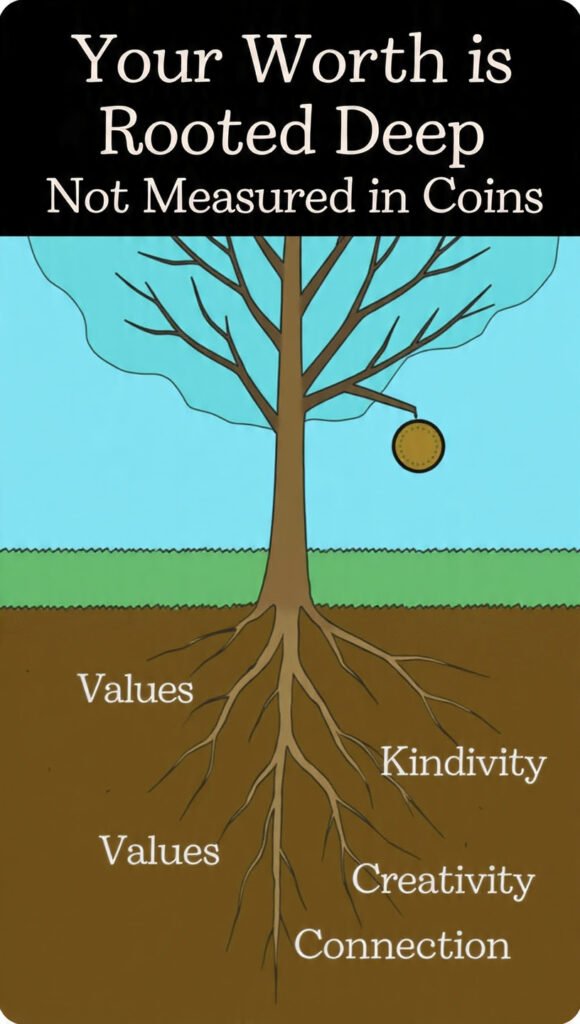
- Actionable Step: Create a “Worth List.” Write down qualities, skills, relationships, and contributions that have nothing to do with money. Examples: your kindness, your sense of humor, your ability to listen, your dedication as a friend.
- Expert Tip: Place this list where you’ll see it daily. This begins the neural rewiring of associating “value” with this new, broader list.
Phase 3: Practical Disassociation
This is where you put new thinking into daily life.
- Actionable Step: Implement a “Pause & Redirect” practice. When a money-worth thought arises, pause. Consciously state: “My value is separate from this number. My worth includes [item from your Worth List].”
- Expert Tip: Use tools like mindful breathing during this pause. The Reality Architect framework provides specific meditations designed to stabilize identity during financial stress.
Phase 4: Integration & New Action
Your new mindset seeks expression through new choices.
- Actionable Step: Make one small decision purely from internal desire, not financial identity. It could be taking a class for joy, setting a boundary, or starting a creative project with no monetization plan.
- Expert Tip: Measure success by feelings of alignment and authenticity, not just external results. This phase solidifies the new identity. Continuous practice is key.
Top 5 Common Mistakes to Avoid
Here are the most frequent mistakes I’ve helped clients correct:
Mistake #1: Spiritual Bypassing the Problem
Jumping to “money is just energy” without processing the real, painful feelings of shame and inadequacy leaves the wound unhealed. You might affirm abundance while still feeling worthless inside.
Mistake #2: Neglecting the Practical
Building internal worth is implemented in a material world. Failing to also manage practical finances—budgeting, planning—can create new stress that undermines your emotional work.
Mistake #3: Chasing a Feeling, Not Building a Foundation
Don’t try to feel “100% worthy” on day one. Start with noticing. A small moment of separation now is better than waiting for a perfect, permanent state of confidence.
Mistake #4: Isolating Yourself
Keeping this struggle secret reinforces shame. Sharing your journey with a trusted friend or guide, like those found through The Reality Architect, provides support and perspective.
Mistake #5: Not Anchoring in Daily Reality
Treating this work as purely metaphysical ignores the power of consistent, grounded action. The most successful integrations happen when internal shifts are paired with small, tangible changes in daily life.
Advanced Integration: Blending Mind, Energy, and Action
Once you’ve established the basics, consider these deeper integrations:
- Leverage Conscious Language: Tools like specific mantra work are excellent for reprogramming subconscious beliefs about scarcity and worth.
- Foster an Energy of Sufficiency: Practice feeling “enough” in non-financial areas (time, love, rest) to build the neural template for financial sufficiency.
- Stay Updated on Self-Concept Science: The field of neuroplasticity evolves. Understanding how the brain changes supports your practice.
- Benchmark Against Your Inner Compass: Regularly check if your financial goals align with your core values, not societal expectations.
Conclusion: Your Path to True Valuation
Separating money from self-worth isn’t about denying ambition. It’s about building an identity foundation so solid that financial winds cannot shake it.
Let’s revisit what truly matters:
- Start with awareness – See the link without judgment.
- Follow a proven process – The four-phase strategy provides a reliable map.
- Avoid common pitfalls – Spiritual bypass and isolation hinder progress.
- Anchor in daily practice – Consistency bridges the gap between knowing and being.
The insight you’ve gained is a starting point. Its real value is realized through application. The difference between understanding this concept and living it is your next conscious choice.
Ready to Architect a New Reality?
Don’t let this remain an idea. The most profound changes begin with a single, committed step.
Your Next Step: Access our free guide, “The Foundation of Worth,” to walk through the exact process outlined here. It includes:
- Daily journal prompts for Phase 1 awareness
- A template for your personal Worth List
- Audio guidance for the Pause & Redirect practice
- A values-based financial intention worksheet
Access Your Free Guide to Building Unshakeable Worth
Join a community redefining success from the inside out.
About the Author
A guide at The Reality Architect with over a decade of experience integrating metaphysical principles with practical life change.
They have supported hundreds in dissolving the link between external circumstances and internal worth and are passionate about helping individuals build lives of authentic confidence and purpose through actionable, heart-centered frameworks.

Frequently Asked Questions
What is the biggest misconception about money and self-worth?
The biggest misconception is that caring about money means you’re materialistic. You can care deeply about financial well-being and freedom without letting it define you. The issue is the link, not the currency.
How long does it typically take to feel a change?
With consistent daily practice, many notice a shift in their automatic reactions within 3-4 weeks. Building a stable, new foundation of self-worth typically integrates over 3-6 months of dedicated work.
What if my practical financial situation is genuinely difficult?
This work is not a substitute for practical action. It is the foundation that makes practical action—like seeking better employment, learning new skills, or budgeting—more effective and less emotionally draining. The Reality Architect approach always blends inner and outer work.
Can someone with high income struggle with this?
Absolutely. The link can manifest as anxiety about losing status, “imposter syndrome” where success feels unearned, or using wealth as a shield. The pattern of external validation is the same, regardless of the number’s size.


